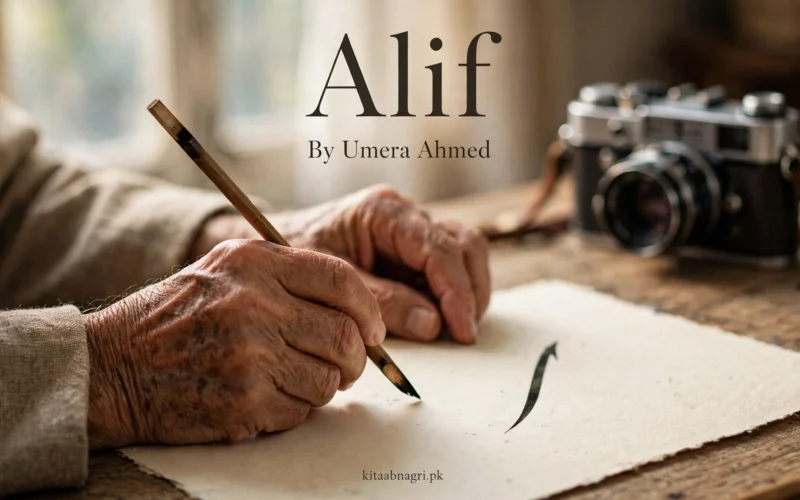
Alif Novel By Umera Ahmed is the story of two people standing at opposite ends of the same emptiness. Qalb-e-Momin is a celebrated filmmaker whose fame and money no longer satisfy him. Momina Sultan is a struggling actress who once dreamed of becoming a calligrapher and joined the film world only to support her family. Umera Ahmed, one of the most widely read novelists in Urdu literature, uses their meeting to ask a quieter question than most novels dare: what does it really mean to begin again? The title, Alif, the first letter of the Urdu alphabet, becomes the novel’s symbol of that new beginning.
| Novel Name | Alif |
| Writer | Umera Ahmed |
| Language | Urdu |
| Category | Umera Ahmed Novels |
| File Format |
Alif Novel By Umera Ahmed Story Overview
The novel moves between two very different lives. Qalb-e-Momin grew up writing letters to Allah, a lonely child asking for his absent father to come home. He becomes a famous director, yet his bold films feel hollow, and his bond with his mother, Husn-e-Jahan, stays strained by old wounds. Forced to give up calligraphy, the art she loved, Momina Sultan acts in films to pay for her ill brother’s treatment, guarding her dignity in an industry that rarely rewards it. After her brother’s death, Momin decides to direct a film called Alif, a story drawn from his own life, and casts Momina in it. Their first meetings are tense, his pride against her grace, yet both begin a path of reckoning. Through letters, diaries, and memories, above all the letters of his late grandfather, the devout Sufi Taha Abdul Ala, the story uncovers the truth about his family, his name, and the purpose he keeps running from.
Main Characters
Qalb-e-Momin
Momin is the novel’s restless centre. Outwardly he has everything the film world promises: success, wealth, admiration. Inwardly he is still the boy who wrote to Allah and never got the answer he wanted. His name means the heart of a believer, yet the novel keeps measuring the gap between that name and his life.
Momina Sultan
Momina is the story’s quiet strength. She did not choose acting; fate pushed her into it when her family needed money for her brother Jahangir’s treatment. She had dreamed instead of calligraphy, of shaping the letter Alif with a reed pen, and that lost dream becomes the thread tying her to Momin. She is resilient, spiritually inclined, and unwilling to trade her self-respect for comfort.
Taha Abdul Ala
Taha Abdul Ala is Momin’s grandfather, a pious Sufi whose presence shapes the novel even after his death. His letters to Momin challenge every excuse Momin has built around his life. He is the spiritual root Momin cut himself off from and must find again.
Husn-e-Jahan
Husn-e-Jahan is Momin’s mother, a former actress and dancer whose life was marked by heartbreak and sacrifice. Momin grew up judging her, and his anger at the world began as anger at her. As her past unfolds, he must see her not as a symbol of the glamour he despises, but as a woman who paid heavily for her choices.
Central Conflict
The deepest conflict is inside Momin himself. He has built a life on fame and control, yet every success leaves him emptier, and his grandfather’s letters keep asking questions he cannot answer. His clash with Momina sharpens this struggle, because her faith and dignity mirror what he has lost. He blamed Husn-e-Jahan for his broken childhood, but the truth about her sacrifices and his father’s disappearance forces him to rebuild that story. A third conflict belongs to Momina: she must survive an industry that wants to use her and still choose the harder, cleaner path. The novel gathers these struggles into one movement, from worldly love toward divine love.
Themes and Writing Style
Faith is the clearest theme, but Umera Ahmed treats it as a lived struggle rather than a slogan. Alif suggests that pain can be a doorway: the wounds of Momin, his mother, and Momina all become the ground on which each turns back toward Allah. The emptiness of worldly success is a second theme: fame, money, and applause fill a room but not a heart. The letter Alif, first and simplest, stands for every beginning, and Momina’s love of calligraphy suggests that beauty made with sincerity can itself be worship. Each chapter ends with a question the next must answer, which keeps the novel moving.
Who May Enjoy This Novel
Alif suits readers who want fiction that takes faith seriously without turning preachy. If the spiritual journeys in Umera Ahmed’s other novels moved you, this one reaches deeper into its characters’ inner lives. It also suits readers curious about the world behind the screen, where much of the story unfolds. It may not suit readers looking for a light romance or a fast plot. The novel asks for patience, and it repays that patience with an ending many readers describe as deeply moving.
Related Novels You May Like
If Alif’s journey toward faith stayed with you, Peer e Kamil Novel By Umera Ahmed is the natural next step, a long search for guidance and redemption. Its direct sequel, Aab e Hayat Novel By Umera Ahmed, continues into marriage and parenthood. For another emotional novel by the same writer, Amar Bail Novel By Umera Ahmed sets a serious love story against bureaucracy, power, and damaged families. Readers drawn to the novel’s meditation on destiny will find Dana Pani Novel By Umera Ahmed equally powerful, a classic about love and what is written for every soul. And for a shorter, psychologically intense story by the same writer, Hum Kahan Ke Sachay Thay Novel By Umera Ahmed explores jealousy and false blame inside a family.
Reader Questions and Final Thoughts
FAQs
Who is the writer of Alif?
Umera Ahmed, the Pakistani novelist and screenplay writer, wrote Alif. She is also known for Peer e Kamil, Shehr-e-Zaat, and several popular television dramas.
What is the story of Alif about?
It follows Qalb-e-Momin, an inwardly empty filmmaker, and Momina Sultan, a struggling actress who once dreamed of calligraphy. Cast in a film drawn from his own life, both face questions of faith and forgiveness.
Who are the main characters in Alif?
The central figures are Qalb-e-Momin, the filmmaker; Momina Sultan, the actress; Taha Abdul Ala, the devout Sufi grandfather whose letters guide Momin; and Husn-e-Jahan, his mother, whose past shapes his view of the world.
Is the TV drama Alif the same as the novel?
The novel came first and was later adapted into a popular Pakistani television drama of the same name. This article is about Umera Ahmed’s novel, not the screen version.
Is Alif a romantic novel?
It does hold romantic elements, but its main concern is spirituality, self-discovery, and the bond between human beings and Allah.
Final Words
Alif endures because it treats the reader as someone able to ask hard questions. Momin’s slow return, Momina’s quiet strength, and a grandfather’s letters make this more than a film-world story. It is about what it costs to start over, and why that price is worth paying.
3 comments