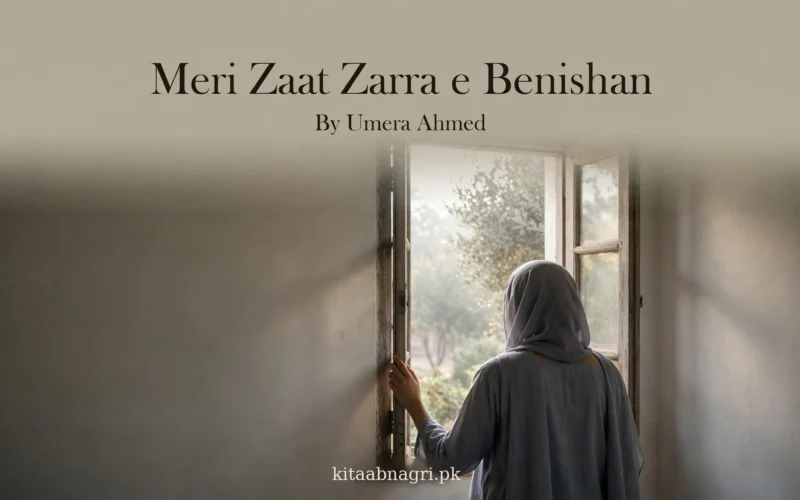
Meri Zaat Zarra e Benishan Novel By Umera Ahmed is one of Umera Ahmed’s most moving early works, a story of injustice and unshaken faith. The novel follows Saba, a gentle and God-fearing woman whose world is shattered when she is accused of a sin she never committed. Abandoned by her husband and judged by the very people who should have protected her, Saba holds on to only one thing: her trust in Allah. What makes this novel unforgettable is not only its pain but its patience. Readers who value emotional depth and spiritual strength will find this story impossible to forget.
| Novel Name | Meri Zaat Zarra e Benishan |
| Writer | Umera Ahmed |
| Language | Urdu |
| Category | Umera Ahmed Novels |
| File Format |
Meri Zaat Zarra e Benishan Novel Story Overview
The story of Meri Zaat Zarra e Benishan Novel follows Saba, a modest and dignified woman married to Arfeen Abbas. Her simple life is filled with quiet contentment until a false accusation of adultery tears it apart. The charge comes from within the family, and instead of standing by his wife, Arfeen believes the lie. He divorces Saba, leaving her homeless with nothing but her dignity and her faith.
What follows is a journey of extraordinary patience. Saba refuses to answer cruelty with bitterness. She accepts her suffering with grace and places her case before Allah, the only judge she truly fears. Years later, a young woman named Sara, Saba’s daughter, steps into the picture. Through Sara, the past resurfaces, and the truth buried for so long finally comes to light. Those who wronged Saba must face what they did, while Saba herself remains a symbol of forgiveness.
The title translates roughly to “My being, a particle without identity,” capturing Saba’s place in a society that refused to see her worth. It is a story about a woman whom everyone tried to erase, yet whose faith gave her a strength no accusation could take away.
Main Characters of the Novel
Saba
Saba is the heart of the novel. She is gentle, modest, and deeply connected to her faith. When she is falsely accused, she does not answer cruelty with cruelty. She bears the injustice with remarkable patience and refuses to lose her trust in Allah. Her silence is not weakness; it is her greatest strength.
Arfeen Abbas
Arfeen Abbas is Saba’s husband, a man who fails the most important test of his life. When a false accusation is placed before him, he does not investigate and does not trust his wife. His decision to divorce Saba sets the tragedy in motion, and his character shows how weakness can cause as much harm as cruelty.
Sara
Sara is Saba’s daughter, and her arrival years later reopens the wounds of the past. She connects what happened to Saba with the present, and through her, the truth about Saba’s innocence finally reaches those who once condemned her.
Arfeen’s Mother
Arfeen’s mother drives much of the suffering in the novel. Her hatred of Saba knows no limits, and she turns the entire household against her daughter-in-law. Her bitterness ruins many lives, including her own family’s happiness.
The Central Conflict
The central conflict is the battle between truth and falsehood within a family. A false accusation is the spark, but the real conflict runs deeper: it asks whether a woman’s character can be destroyed by lies, and whether those lies can ever truly stand. Saba’s husband and his family choose suspicion over trust, while Saba chooses patience over protest. As the years pass, the conflict becomes a slower struggle: the wait for justice. Saba does not chase it; she believes it will come from Allah in its own time. This quiet certainty gives the novel its spiritual power.
Themes and Writing Style
The most important theme is faith in divine justice. Saba’s unshaken belief that Allah sees everything carries her through years of loneliness and humiliation. Forgiveness is another central theme. Despite all she suffers, Saba holds no hatred in her heart, and the novel presents forgiveness as strength rather than surrender. The story also examines how quickly society judges women, and the damage that gossip and jealousy can do inside a home.
Umera Ahmed writes simply yet deeply, building feeling through small, honest moments. The dialogue feels natural, and the spiritual reflections never sound forced. Readers who admired the spiritual journeys in Peer e Kamil Novel By Umera Ahmed will recognize the same sincere voice here. Like Alif Novel By Umera Ahmed, this novel treats faith not as decoration but as the very foundation of its characters’ lives.
Who Will Enjoy This Novel
This novel is for readers who like stories with deep emotional and spiritual meaning. If you enjoy novels about strong women who face injustice with dignity, you will connect with Saba. Readers interested in faith, patience, and divine justice will find much to reflect on. Its pace is slow and its mood is heavy, but its message is lasting.
Related Novels You May Like
If this novel moved you, these Umera Ahmed novels explore similar emotional and spiritual territory. Aks Novel By Umera Ahmed examines questions of identity and self-worth through a woman searching for her place in the world. Man o Salwa Novel By Umera Ahmed follows women tested by poverty, desire, and moral choices, with the same honest look at human weakness. Hum Kahan Ke Sachay Thay Novel By Umera Ahmed is another powerful family drama where hidden truths and long-buried secrets reshape the lives of everyone involved.
Reader Questions and Final Thoughts
FAQs
What is the meaning of the title Meri Zaat Zarra e Benishan?
The title means “My being, a particle without identity.” It reflects how Saba is treated — as someone whose worth is denied — though her character is greater than anyone admits.
Who is the main character of the novel?
Saba is the main character. She is a modest, God-fearing woman who is falsely accused, divorced by her husband Arfeen Abbas, and left to rebuild her life through patience and faith in Allah.
Is Meri Zaat Zarra e Benishan based on a true story?
There is no verified evidence of real events behind it. It is fiction by Umera Ahmed, though its themes of false accusation and social injustice feel real to many readers.
Was the novel adapted into a drama?
Yes. It was adapted into a popular television drama that kept the novel’s central story of Saba’s suffering, faith, and patience.
What is the main message of the novel?
Truth cannot be buried forever, and patience and faith in Allah carry a person through the worst injustice. Forgiveness, the novel shows, is a strength rather than a weakness.
Final Words
Meri Zaat Zarra e Benishan Novel stands among Umera Ahmed’s most touching works because it speaks to anyone who has ever been judged unfairly. Saba’s journey from disgrace to dignity, carried entirely on the strength of her faith, reminds readers that no lie can erase a person’s true worth. It is a novel that does not just tell a story; it offers comfort to the wronged and a warning to the unjust.
One comment