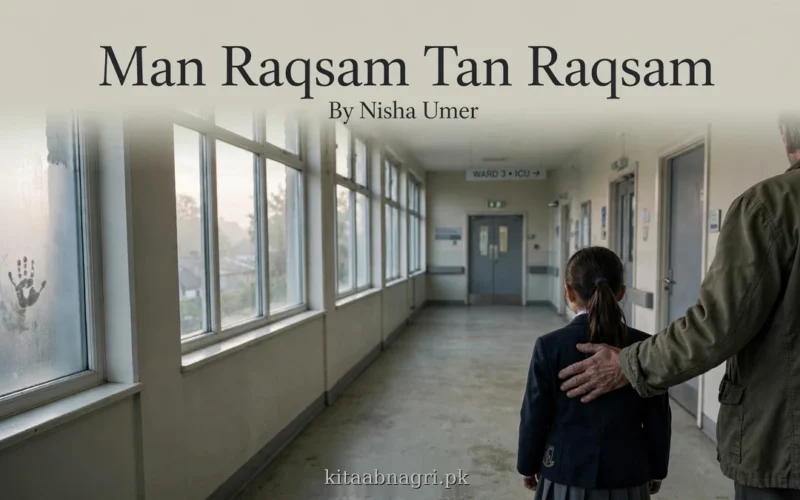
Man Raqsam Tan Raqsam Novel By Nisha Umer is a complete Urdu romantic novel that opens with a deathbed promise and follows what that promise costs the two people it binds. An age-difference emotional drama, it trades the usual courtship plot for something rarer: a marriage entered out of duty that must slowly earn the right to be called a bond.
The result is a novel readers describe as heavy, tender, and honest: it never romanticizes the circumstances that bind its hero and heroine, and asks instead how loyalty and compassion can grow where love was never planted.
| Novel Name | Man Raqsam Tan Raqsam |
| Writer | Nisha Umer |
| Language | Urdu |
| Category | Age Difference Based Novels |
| File Format |
Man Raqsam Tan Raqsam Novel By Nisha Umer Story Overview
The story begins in the home of Shah Wali, a strict and status-conscious businessman, and his wife Farah, a distant mother. Their daughter Sawri grows up in a house where love is thin and appearances matter more than affection. When a colleague tips Shah Wali off, he discovers Farah dining with her lover at a restaurant, confronts them, and divorces her — and the humiliation shatters the fragile order of the household.
Deeply disturbed, Shah Wali then meets with an accident, and on his deathbed he calls his friend and business partner Salar to his side. His last wish is startling: Salar must take care of Sawri — by marrying her. At that moment Sawri is only thirteen, younger even than Salar’s own son Hadi, who is fifteen. Salar, whose wife has already left him, understands what his dying friend fears: Shah Wali’s wealth-hungry extended family circling a vulnerable, motherless girl.
Salar honors his friend’s last wish and marries Sawri — not for love, but to protect her. What follows is the heart of the novel: two people bound by a promise neither chose, learning to live inside an age-difference marriage the world refuses to accept without judgment, and tracing a slow journey from duty toward a bond rooted in loyalty, trust, and compassion.
Main Characters
Sawri
Sawri is the novel’s emotional center: a thirteen-year-old girl who loses her father to betrayal and tragedy before she understands the adult world. Thrown into a marriage she never asked for, she must grow up faster than any child should — learning what it means to trust the man who married her to keep her safe.
Salar
Salar is Shah Wali’s friend and business partner, a man whose wife has already left him, and the father of Hadi and Zoha. He is the novel’s moral anchor: he takes a dying friend’s impossible request seriously and carries it through at great cost, marrying Sawri as an act of protection rather than desire.
The Central Conflict
The novel’s central question is simple: can a marriage built on a promise rather than choice become something real? Sawri enters the union as a child; Salar enters it as a guardian. The years between them are a gap in experience and authority, and the novel never pretends otherwise.
Around them, society presses in — the wealth-hungry extended family waiting for a chance at Shah Wali’s fortune, and a world that reads scandal into a bond meant as shelter. He must learn that protection without emotional honesty is another kind of distance; she must decide, when old enough to choose, what this marriage will mean.
Themes and Writing Style
Duty runs through every chapter. Salar’s marriage to Sawri is an act of loyalty to a dead friend, and the novel treats that loyalty with complete seriousness — never as a mistake to be undone, only as a responsibility to be carried with honor. Beside it runs the theme of emotional growth: both leads must mature into the roles life has forced on them.
Nisha Umer writes in direct, unadorned Urdu, heavy on interior feeling rather than melodrama: long silences, small kindnesses, and the slow accumulation of trust. The result is an emotional drama that earns its tears instead of demanding them.
Who May Enjoy This Novel
This novel is for readers who love emotional Urdu romances where the stakes are human rather than glamorous — stories of forced bonds that must be honored, told with seriousness. Readers who prefer light, comic romances may find it heavy; those who value loyalty, patience, and slow emotional payoff will find it unforgettable.
Related Novels You May Like
Readers who finish this story usually reach for more age-difference romances handled with the same honesty:
- Jugnu Novel By Husny Kanwal — another age-gap love story where a young heroine and a much older hero defend their bond against family tradition and social judgment.
- Haal E Dil Novel Season 1 By Rimsha Hussain — an emotional age-gap romance about a young woman and a proud, older hero bound by circumstances neither chose.
- Tashnagi e Yaar Novel By Alishey Khan — a forced marriage between an older, powerful man and a younger woman that slowly turns from hostility into mutual respect.
- Jaan Novel By Shaheena Chanda Mehtab — an age-difference romance where patient devotion must overcome fear, past wounds, and society’s judgment.
- Toor e Mohabbat Novel By Mamoona Nasrullah — a tender story of a young bride winning over a widower’s two children, for readers moved by Salar’s duty to Hadi and Zoha.
Reader Questions and Final Thoughts
FAQs
Who is the writer of Man Raqsam Tan Raqsam novel?
The novel is written by Nisha Umer, an Urdu novelist known for emotional romantic fiction built around strong family drama and unusual premises.
What is the story of Man Raqsam Tan Raqsam about?
It is the story of Sawri, a thirteen-year-old girl left alone after her father’s death, and Salar, his friend, who marries her to honor a dying wish and shield her from his extended family. The novel follows how they navigate an age-difference marriage built on duty, loyalty, and growing trust.
Is Man Raqsam Tan Raqsam based on an age difference?
Yes. The age gap is the novel’s central theme: Sawri is only thirteen when the marriage takes place, while Salar is old enough to be her father’s friend. The story explores how both of them, and the society around them, deal with that gap.
Is Man Raqsam Tan Raqsam a complete novel?
Yes, the edition shared here is the complete novel in PDF format. A second season continuing Sawri and Salar’s story also exists for readers who want more after the final page.
Where can I read or download Man Raqsam Tan Raqsam?
Use the Read Online link to open the complete PDF in your browser, or the Download Now link to save it to your device. Both links are given in the details section above.
Final Words
Man Raqsam Tan Raqsam Novel By Nisha Umer is not a light read, but it is a memorable one: a story that begins with a deathbed promise and ends with a bond that loyalty built. Read it when you want a novel that treats duty as seriously as love — and shows that sometimes, the two are the same thing.